

Mayank Desai
UI/UX Designer & Framer Developer
Share On




At the heart of every great user experience lies a deep understanding of human psychology. The most successful digital products are not built purely on visual skill or technical precision - they are built on an informed understanding of how the human mind processes information, forms expectations, and makes decisions. For UI/UX designers and product design professionals, psychology is not a soft add-on to the design process; it is a foundational pillar of effective design strategy. When designers understand concepts like cognitive load, priming, and decision-making bias, they are equipped to create interfaces that reduce friction, build trust, and guide users toward meaningful outcomes. This guide explores the key psychological principles shaping modern user experience design.
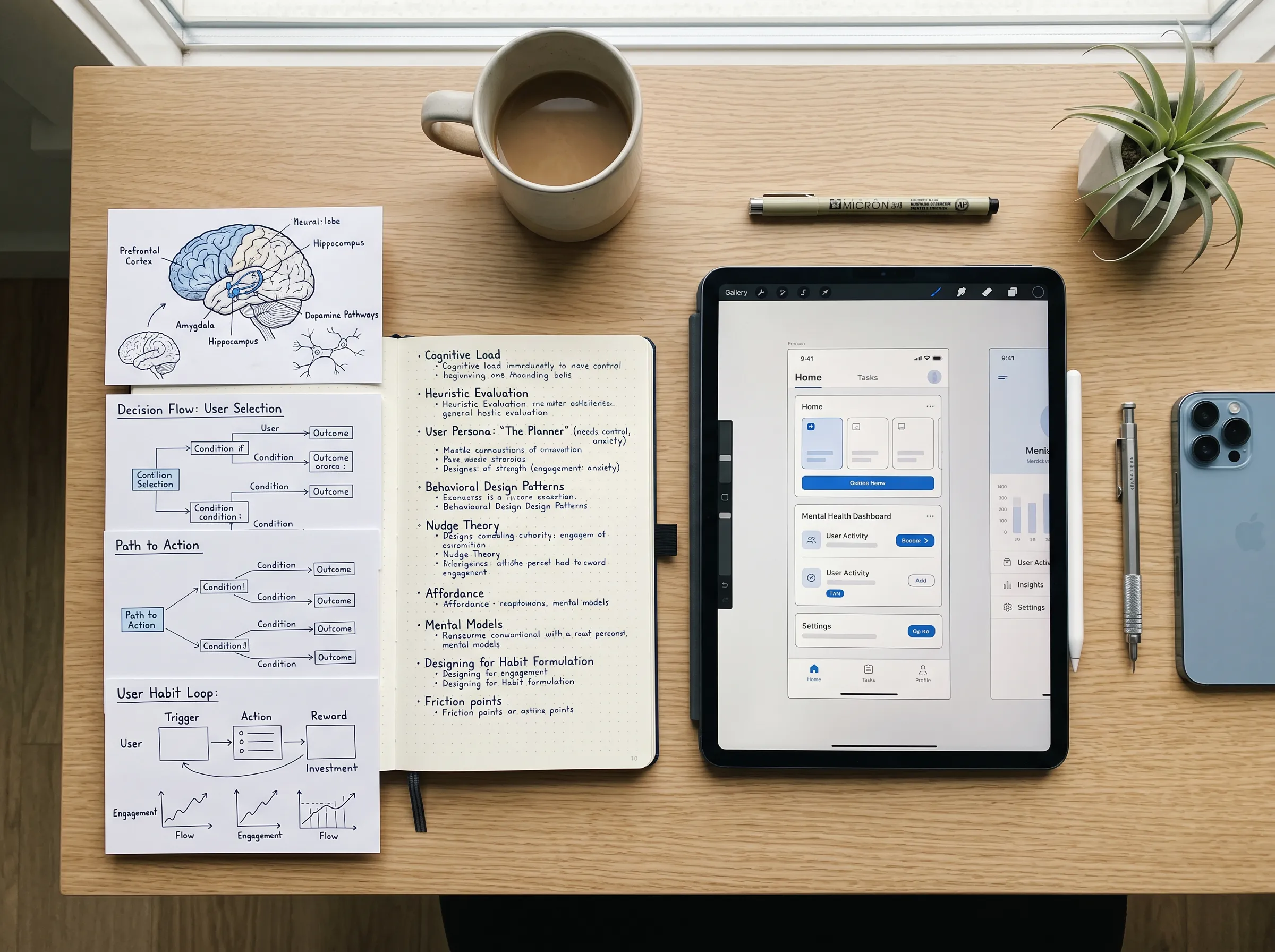
Understanding the Core Concept: Why Psychology Belongs at the Center of UX Design
User experience design has always been fundamentally about people. But the transition from designing for people to designing with an understanding of how people think is what separates average interfaces from truly exceptional ones. Cognitive psychology, behavioral science, and perception theory all offer design teams a structured lens through which to evaluate their decisions - not just aesthetically, but functionally and emotionally.
When a UI/UX designer understands that users do not read screens linearly, that they scan for familiar patterns, and that they make instinctive judgments within milliseconds of landing on a page, it changes every design decision. Layout hierarchy, button placement, color contrast, content chunking - all of these become informed, intentional choices rather than stylistic preferences. Integrating psychology into the design process is what transforms a functional interface into one that genuinely resonates with its audience.
Hick's Law: Simplifying Choices to Accelerate User Decisions
One of the most practically applicable principles in UX design psychology is Hick's Law, which states that the time it takes for a person to make a decision increases proportionally with the number of choices available. In simple terms: more options create more hesitation. This has profound implications for product design, particularly in navigation structures, onboarding flows, and any screen that asks a user to make a selection.
A common real-world example is the difference between a product grid showing four items versus twelve. The user shown four options makes a faster, more confident decision. The user shown twelve experiences what psychologists call choice overload - a state where decision-making becomes cognitively taxing, often resulting in abandonment rather than action. For UI/UX designers, Hick's Law is a compelling argument for progressive disclosure: revealing options incrementally rather than all at once. The design principle is straightforward - fewer, well-prioritized choices consistently outperform exhaustive option lists in both usability testing and real-world conversion performance.
Confirmation Bias: Designing for What Users Expect to Find
Confirmation bias is the psychological tendency for people to seek out, interpret, and recall information in ways that confirm their pre-existing beliefs or expectations. In the context of UX design, this means that users come to an interface with mental models already formed - expectations about where a navigation menu should be, what a shopping cart icon should look like, or how a form should behave. When an interface aligns with these expectations, users feel confident and in control. When it contradicts them, confusion and distrust follow.
For product designers, the practical implication of confirmation bias is significant. It reinforces the value of design conventions and established UI patterns - not because creativity should be suppressed, but because defying user expectations without clear reason creates unnecessary cognitive friction. It also surfaces an important challenge within the design process itself: designers and teams can fall victim to confirmation bias when evaluating their own work, unconsciously seeking feedback that validates existing decisions rather than challenging them. Building diverse user research practices and structured usability testing into the design workflow is the most effective antidote to this bias affecting design quality.
Priming: How Early Visual Cues Shape User Behavior
Priming is a cognitive phenomenon where exposure to one stimulus subtly - and often unconsciously - influences how a person responds to a subsequent one. In everyday life, seeing the color red might prime thoughts of urgency or danger. In digital product design, priming operates continuously across every screen a user encounters.
The landing page a user sees before entering a checkout flow primes their emotional state for that transaction. The illustration style used in an onboarding sequence primes users' expectations about the product's personality and level of complexity. Even the order in which information is presented primes what users consider most important. Skilled UI/UX designers use priming deliberately - establishing visual and tonal consistency that guides users toward the right emotional and cognitive state for each interaction. A wellness app might use soft gradients and rounded typography early in an onboarding flow to prime feelings of calm before asking users to input personal health data. This is not manipulation - it is thoughtful, empathetic design strategy applied at the level of human perception. The most effective design systems are built with priming effects consciously considered at every stage of the user journey.
Cognitive Load: Reducing Mental Effort Across Every Screen
Cognitive load refers to the total mental effort being used in a person's working memory at any given moment. Every interface element - every label, icon, animation, and layout choice - either contributes to or reduces the cognitive load placed on the user. When cognitive load is too high, users make errors, feel frustrated, or disengage entirely. When it is well-managed, users move through an interface fluidly, feeling capable and satisfied.
In practical UI/UX design terms, managing cognitive load means making deliberate decisions about information density, visual hierarchy, and interaction complexity. It means resisting the urge to surface every feature on a single screen. It means using whitespace not as empty space but as breathing room for the mind. It means labeling interactive elements clearly rather than relying on clever-but-ambiguous iconography. The three types of cognitive load - intrinsic (inherent task complexity), extraneous (unnecessary interface complexity), and germane (mental effort that builds useful understanding) - give designers a framework for evaluating their work against user mental capacity. The best product design systems are those that minimize extraneous load while preserving just enough germane load to keep users engaged and learning.
Applying Psychology to the Design Process: From Research to Execution
Understanding psychological principles is valuable. Applying them systematically throughout the design process is where their real power is realized. The most effective design teams integrate behavioral insights at every phase - from user research and persona development through wireframing, prototyping, usability testing, and final delivery.
During research, understanding confirmation bias helps designers ask better, more neutral interview questions. During information architecture work, Hick's Law guides decisions about navigation depth and category structure. During visual design, priming theory informs color palette choices, imagery tone, and typographic hierarchy. During usability testing, cognitive load theory provides a lens for interpreting where users hesitate, backtrack, or express confusion. And as AI in design tools begins to automate pattern generation and layout suggestions, psychological literacy becomes even more critical - because AI can optimize for visual patterns at scale, but only human designers can evaluate whether those patterns genuinely serve the mental and emotional needs of real people.
Common Challenges and Solutions: When Psychology Gets Complicated in Practice
One of the most common challenges designers face when applying UX psychology is the tension between business objectives and user-centered principles. A stakeholder may request more options on a screen in the belief that more choice signals more value. A product team might resist simplification out of concern that it reduces perceived functionality. In these moments, psychological principles become the designer's most persuasive evidence - rooted in research, testable through prototyping, and communicable through clear user experience metrics.
Another challenge is designing for diverse user populations. Psychological biases and cognitive patterns are not universal - they are shaped by culture, age, literacy, and prior digital experience. A priming strategy that works effectively for one demographic may be entirely ineffective or even counterproductive for another. This is why inclusive research practices - testing across a representative range of users - are non-negotiable in professional product design. Psychology provides the framework; research fills in the context-specific details that make that framework actionable.
Takeaways and Future Trends: Psychology in the Age of AI-Driven Design
As AI in design becomes more prevalent - generating layouts, personalizing interfaces, and predicting user behavior at scale - the importance of psychological literacy among designers is only growing. AI systems are increasingly capable of pattern recognition and optimization, but they operate on behavioral data. The designers who understand why certain patterns work at a psychological level will be the ones best positioned to guide, evaluate, and refine what AI produces.
The future of UX design psychology is likely to involve more sophisticated personalization - interfaces that adapt not just to a user's stated preferences, but to their cognitive state, attention levels, and decision-making context in real time. Ethical frameworks will become as important as functional ones, ensuring that psychological principles are used to genuinely serve users rather than to exploit behavioral vulnerabilities. For designers committed to human-centered practice, this is a moment of enormous opportunity - and psychology remains the most enduring tool in the craft.
Explore more insights on UI/UX design, product design strategy, and creative process across this portfolio.
Tags: UX Design Psychology, UI/UX Design, User Experience, Product Design, Design Strategy, Cognitive Load, Hick's Law, Confirmation Bias, Priming, Design Process, Human-Centered Design, AI in Design